Here Comes the Wind
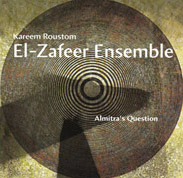
El-Zafeer’s Almitra’s Question
CD Review by Sami Asmar
Compositions that fuse Arab and Western music are neither new nor rare. Fusion records that achieve their goal tastefully, however, are not many. A notably intriguing new CD called Almitra’s Question has just been released (Fuller Street Music) by composer and guitarist Kareem Roustom that reflect the composer’s depth and performers’ talent.
Kareem is schooled and trained in jazz and has composed for film and television. He is also an experienced ‘ud player who has been commissioned to orchestrate classical pieces of Arab music. He created El-Zafeer Ensemble and produced its debut CD as a reflection of his multicultural heritage, Syrian and American parents. El-Zafeer is Arabic for Zephyr, wind that blows from west to east. It was chosen because this music comes from the West and looks to the East.
The wind of this record, however, has circled the globe. Roustom’s music takes to the East the spirit of harmony, not a component of traditional Arab music, and brings to the West the influence of sufi music. The latter is reflected in classical Arab rhythms common to spiritual ceremonies and performance of Muwwashshahat, classical works in the style of Arab Andalucia.
With a title inspired by Kahlil Gibran, Roustom draws on the strongest common element between jazz and Arab music, improvisation. With the talented young violinist, Hanna Khoury, also trained in both genres, the improvisations impressively fuse harmony with modal maqamat, where appropriate. At the very end of the pience “Salwa’s Last Dance,” for example, a theme that was played earlier over thick jazz harmonies is played in the maqam Bayyati: a scale that uses quarter tones.
The answer to Almitra, however, may be in the rhythms. With contributions from several renowned Arab-American and American percussionists such as master drummers Souhail Kaspar and Karim Nagi Mohammed as well as Catherine Alexander, jazz compositions and improvisations are played to the beautiful background of classical Arab iqa’. The wonderful long meter called sama’i (10/8) was used in the arrangement called Naima, the timeless ballad by jazz giant John Coltrane. Roustom chose the 16/4 meter called nawakht hindi and 8/4 called masmoudi kabir and many other complex and beautiful meters for the other pieces. He brilliantly arranged O Sacrum Convivium, an odd combination of twentieth century French composer Olivier Messiaen and a mix of traditional Arab rhythms.
Almitra’s Question is simply intelligent. Its wind will hit like a storm.
Link here to group's website: LayaliMusic.com
Copyright © 1999-2005 Turath.org All rights reserved