|
Simon Shaheen Sings For Mohammad Bakri St. Peter’s Church in New York City 17 April 17 2008
By: Farrah Sarafa |
|
|
Simon Shaheen Sings For Mohammad Bakri St. Peter’s Church in New York City 17 April 17 2008
By: Farrah Sarafa |
|
Palestinian oud and violin virtuoso, Simon Shaheen, magnificently performed at New York City’s St. Peter’s Episcopal church in a special concert fundraising for renowned Palestinian actor and director, Mohammad Bakri, who currently suffering extreme injustice and penalty for his film: Jenin Jenin.
Over 250 people attended the ceremony which, thanks to the defense committee headed by Lisa Capone as well as Waheed Khalayleh of City Gourmet for catering, was a complete success with nearly $12,000 raised. Maysoon Zayid MC’ed the event bringing needed levity to the dilemma at hand. She introduced Kinan Azmeh and his group, and Mohammad Bakri for the first half. Simon Shaheen appeared in the second half with Yaffa Bakri, Mohammad’s daughter. The evening was filled with delightful champagne, uplifting music—joy—delicious middle-eastern cuisine.
Each song uniquely articulated the truth of the Jenin Jenin controversy. Clarinetist Kinan Azmeh initiated the musical spectacle by generating soulful blends of high-pitched shrieks and low-cadence shrill. In resembling the whistles of blowing desert sand and rain dropping along wooden planks of destroyed village edifice, Azmeh took the audience on a magic-ride. The only Syrian and first Arab clarinetist to win first prize at the Nicolay Rubenstein youth competition, Azmeh played spectacularly. Stirring renditions from his clarinet nestled neatly between the murky shrills, celebratory sparks of the bass and thunderous drummer blows. Each note, haunting crescendo and low-pitch articulated an experience and unique blend of painful joy: A longing to return.
The last song, specifically reminiscent of traditional Syrian weddings opened the audience to the magniloquence and spiritually revitalizing melodic patterns of true classical music. His rhythmical overture seemed to suggest to Mohammad -- to his family -- that the sky would clear. Azmeh’s craft--characterized by topsy-turvy notes quite similar to Arabic calligraphy--unpredictably twisted, flipped and spun. They elevated people to point of rediscovering and remembering Israeli occupation.
Following Azmeh, Mohammad Bakri took the stage to greet and thank the audience. The director/filmmaker and father of six has undergone serious career transformations. His family too has suffered a lot, considering that the splattering of his name over tabloids—has been systematically deployed.
Sick of the occupation, Mohammad is like “Nabil” who in Jenin Jenin says: “We want this occupation to end. They tell us when to breathe. They have shattered our ambitions and our dreams.” Bakri wishes to be released from the penalty he faces: two million shekels or life in prison. Artistically occupied Bakri is being quieted and his stories delayed.
“Dogs bark in order to express themselves, they won’t even let us bark…We are the only people in the world, always under occupation. There are 13,000 of us living in half a square kilometer,” says Akram Abu Alsibaa. Elucidating the catastrophe and seriousness of the Jenin camp, these statements not only highlight the larger issue of land politics, repression, and corruption taking place in Palestine-Israel, but they magnify the importance of free, creative expression, necessary to bring peace/equality.
Following Mohammad Bakri, Palestinian composer and instrumentalist Simon Shaheen, playing the non-fretted Arab lute (oud) took to the stage. Skillfully taking sounds to heights of alternating escalations, high and low pitch--hollow vibrations, the audience persisted to tap along and to notice that each drip-drop and upwardly spiraling crescendo was indicative of Jenin camp.
Jenin Jenin the film--epitomizes these spiraling modems. Young children, older men, tormented elders and uncles bring their excess grieves, their sorrows--to picture, sound and memory. “Israel is not the terrorist, the whole world…(who has turned us a deaf ear) is the terrorist,” says the doctor from the newly destroyed Jenin-hospital. “The efforts of forty-five years were destroyed in five minutes,” says Nabil.
It was during Shaheen’s performance that the pitter-patter of strings pulled –and that the microtonal vibrations, sensitivities—and fluctuating timbres resounded. Resonating decay and uplifting joys—return to dear, lovely home: Palestine. Shaheen’s music re-transported all attendees through Bakri’s films: Jenin Jenin, Since You Left, and others. One sound overlapped with the decaying low of the next, merging and mingling with the ghostly echoes of chaos.
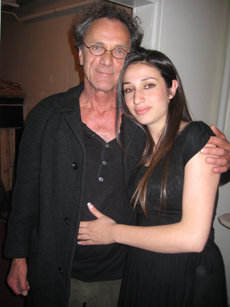
Soon Yaffa took side-stage to the virtuoso, delicately exposing her youthful-hidden skill, which powerfully captivated audience members like a next Fayrouz or Umm Khoultoum. Like her father, she shed light on the culture that we all seek to renew, relive and assist.
The Israeli government ruined Bakri’s life and that of his family, and has endangered the extent to which Yaffa and Mohammad’s five sons may succeed. Mohammad lives in fear that his film may prevent Yaffa from extending far into the Middle-East film experience. The whole time she sang, I remembered Najwa, the young girl in Jenin Jenin who says:
“The camp is like a tall, eminent tree. The tree has leaves and each leaf bears the name of a martyr. I would like to say to the Jews, even if they break a few branches others shall grow in their place; they were not able to reach the top (4:27)”
Copyright © 1999-2008 Turath.org All rights reserved